Prior to D-Day, the USAAF 416th Bomber Group, stationed
at Wethersfield, played a critical role in preparing for
the European invasion, conducting missions primarily against
German coastal defenses, V-1 launch sites, airfields, and
marshalling yards.
On D-Day itself, the 416th carried out two missions in support
of the Allied Expeditionary Forces who, after securing their
beachhead, began the push toward Germany. Following the
initial landings, the Group shifted focus to providing tactical
support for advancing ground troops. It is worth noting
that Wethersfield, along with all USAAF airfields in Essex
and South Suffolk, were supplied with bomber and fighter
munitions stored at Bures
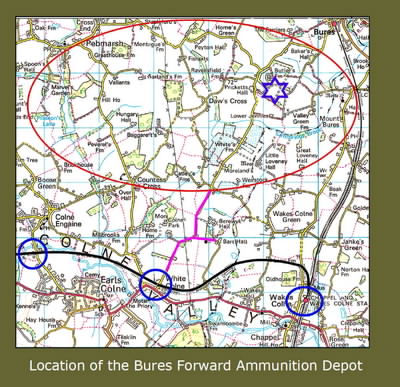
The Bures Forward Ammunition
Depot (FAD) was the largest of three significant sites in
East Anglia, with the other two situated at Earsham in Norfolk
and Barnham near Thetford in Suffolk. From 2005 to 2020,
I undertook a comprehensive research into the activities
and presence of the United States Army Air Force in Bures
during the years 1943 to 1945.
During this period, the United States Army Air Forces (USAAF)
requisitioned the land surrounding Butlers Farm on the Earls
Colne Road, subsequently expanding into minor roads and
the country lanes, to accommodate substantial stockpiles
of bombs and munitions intended for airfields in Essex and
South Suffolk. These munitions were typically transported
by train from Liverpool and Immingham Docks, via the March
(Cambridge) Marshalling Yard onward to Chappel.
The trains passed through
Bures to avoid drawing attention to the nearby Ammunition
Depot.
Consequently, deliveries continued to Chappel despite the
inherent risks as the Luftwaffe frequently targeted the
Viaduct and the Fuel Storage Depot alongside.
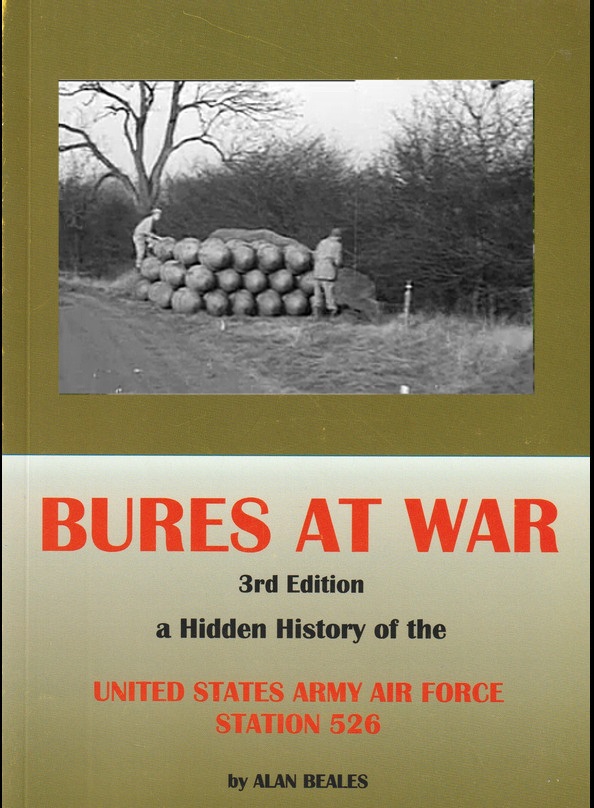
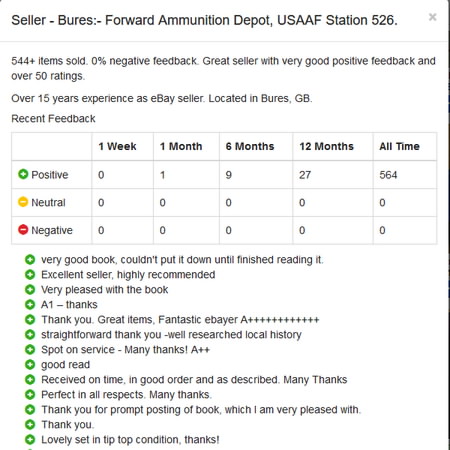
After fourteen years of research,
I published a book on this subject in 2019. The book has
attracted considerable interest in the UK, the USA, and
Europe, leading to a third edition on June 1, 2024, which
sold out within four weeks.
Upon arrival at Chappel, the Munitions were either loaded
onto waiting lorries for distribution to the Bures Forward
Ammunition Depot or transported via the local Colne Valley
Line for storage at the Earls Colne and White Colne sidings.
Due to operational considerations, the Essex airfields were
generally supplied from the Earls Colne Yard and the Bures
Depot to Airfield north as far as Bury St Edmunds.
Notably, aside from its station
number, there are no official records of the Bures Munitions
Depot maintained by either the UK War Department or the
USAAF records in the UK. The only source I found was in
the USA Archives.
My research into this subject
attracted the attention of families of deceased service
members in the United States, who generously provided additional
material. I extensively relied on interviews with residents
from Bures, Pebmarsh, Colne Engaine, Wakes Colne, White
Colne, Earls Colne, and surrounding villages, with contributions
extending as far as Braintree and Rayne.
Numerous self-proclaimed
experts on the Bures Ammunition Depot have delivered talks
on the subject at various local meetings. Unfortunately,
many of their assertions are fundamentally incorrect, often
based on conjecture and hearsay. Online forums on the topic
frequently contain fictionalized accounts. In contrast,
my information is grounded in facts sourced from reputable
archives, such as the USAAF Records held in the United States.
While the exact number of
interviews I conducted is uncertain, it certainly exceeds
eighty. Regrettably, all of these contributors have since
passed away, yet their memories remain invaluable.
Consequently, much of the information I compiled is both
unique and is not available through other sources.
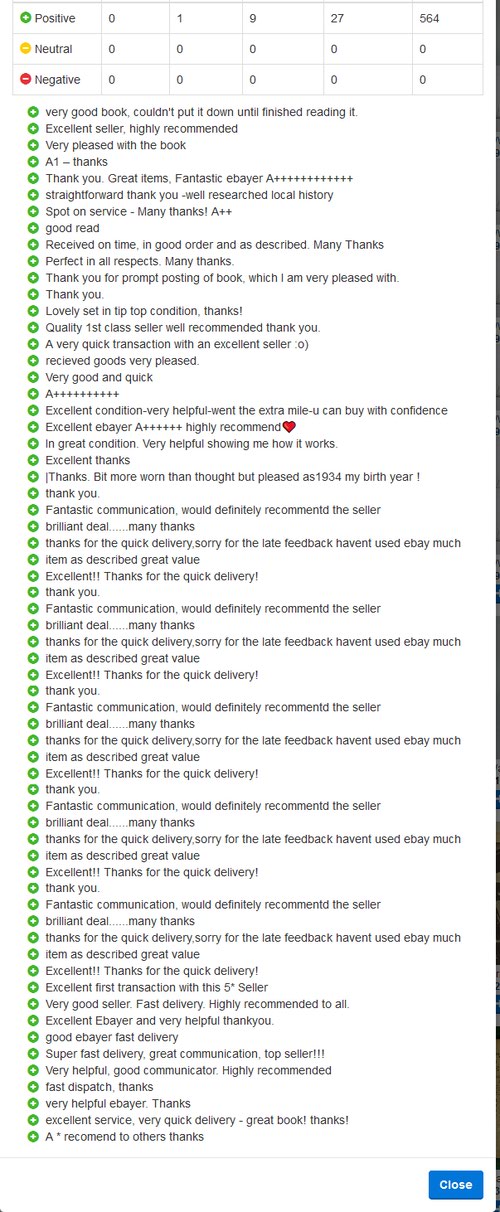
After fourteen years of research,
I published a book on this subject in 2019. The book has
attracted considerable interest in the UK, the USA, and
Europe, leading to a third edition on June 1, 2024, which
sold out within four weeks.
Today in 2026, I am still receiving snippets of new information
from around East Anglia